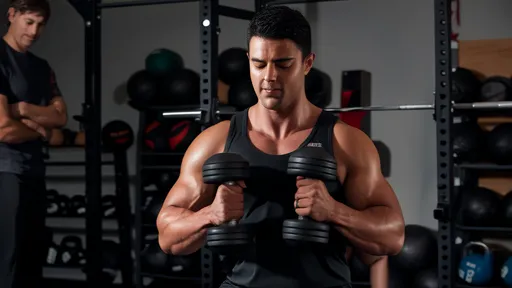
In the evolving landscape of fitness, the free weight section remains a bastion of raw, unadulterated strength training. Among its tools, dumbbells stand as iconic instruments of muscle development, yet an intriguing phenomenon persists: the widespread inability of even seasoned gym-goers to accurately identify dumbbell weights by feel alone. This curiosity sparked the design of a comprehensive blind selection test, conducted across multiple fitness centers, to explore how individuals perceive weight without visual cues. The experiment, involving over 500 participants ranging from novices to professional strength athletes, revealed fascinating insights into human proprioception, psychological biases, and the often-overlooked nuances of equipment design.
The test was structured with meticulous attention to control variables. Each participant was blindfolded and asked to lift a series of dumbbells in random order, with weights ranging from 5 to 50 pounds. After each lift, they estimated the weight. The dumbbells used were all of the same brand and model to eliminate discrepancies in grip texture, balance, or shape that might influence perception. The environment was kept quiet and free from distractions, ensuring that focus remained solely on the tactile and muscular feedback. Participants were also asked about their training frequency, experience level, and whether they typically trained with dumbbells or barbells, adding layers of demographic data to correlate with the results.
One of the most striking outcomes was the consistent underestimation of lighter weights and overestimation of heavier ones. Dumbbells in the 5-15 pound range were frequently guessed to be 20-30% lighter than their actual weight, while those above 40 pounds were often perceived as being up to 25% heavier. This suggests a psychological anchoring effect where the mind recalibrates expectations based on the initial lift. For instance, if a person started with a 20-pound dumbbell and then lifted a 30-pound one, the contrast made the latter feel disproportionately heavy. This bias was universal across experience levels, though to varying degrees.
Experience, however, did play a significant role in accuracy. Professional strength athletes and regular dumbbell users demonstrated a markedly higher rate of correct guesses, particularly in the medium weight range of 20-35 pounds. This aligns with the theory that neuromuscular adaptation and frequent exposure enhance proprioceptive acuity. These individuals could detect subtle differences in resistance that eluded less experienced participants. Yet, even experts were not immune to error at the extremes; the heaviest and lightest dumbbells consistently tripped them up, indicating that sensory perception has its limits regardless of training.
The test also uncovered an unexpected factor: the impact of grip and fatigue. Participants who reported lifting heavier weights earlier in the test tended to become desensitized, leading to greater inaccuracies as the session progressed. Conversely, those who started with lighter weights showed more precision initially but then overestimated subsequent heavier loads. This fatigue-based desensitization points to the role of muscular exhaustion in skewing perception. Additionally, the thickness of the dumbbell handle emerged as a subtle cue. Thicker handles, often associated with heavier weights, sometimes led participants to guess higher than actual, even if the weight was light.
Another fascinating observation was the influence of auditory and haptic feedback. Though the environment was controlled, the sound of the dumbbell being placed on the floor or rack provided subconscious clues. In cases where participants were isolated from all auditory cues using noise-canceling headphones, their accuracy dropped slightly, suggesting that we rely on multisensory input more than we realize. The "clang" of a heavy dumbbell versus the "tap" of a light one creates implicit benchmarks that the brain uses to inform guesses.
The implications of these findings extend beyond mere curiosity. For fitness professionals, understanding these perceptual gaps can inform how they program workouts for clients. For instance, a client might struggle with motivation if they perceive a weight as heavier than it is, leading to premature fatigue or discouragement. Conversely, underestimating light weights might result in undertraining. Equipment manufacturers could also benefit; designing dumbbells with more distinct tactile features, such as textured grips or incremental shape changes, might help users better gauge weight without visual aid.
Moreover, this test highlights the broader theme of human sensory limitation and adaptation. In an era where fitness technology often prioritizes data and visuals—think smartwatches and digital readouts—the humble act of lifting a weight blindfolded reverts us to a primal form of feedback. It underscores that while technology can enhance training, the body’s innate senses remain the foundation of physical experience. This experiment serves as a reminder that sometimes, the most profound insights come from stripping away the non-essential and focusing on the raw interaction between mind, muscle, and metal.
Future research could expand on these findings by incorporating different types of free weights, such as kettlebells or barbells, to see if the same biases hold. Additionally, exploring how factors like age, gender, or specific training disciplines (e.g., powerlifting vs. yoga) affect weight perception could yield even deeper insights. For now, the dumbbell blind test stands as a testament to the complex, often surprising, ways in which we experience and interpret the physical world around us.

By /Aug 14, 2025

By /Aug 25, 2025
By /Aug 25, 2025

By /Aug 25, 2025

By /Aug 25, 2025
By /Aug 25, 2025
By /Aug 25, 2025

By /Aug 25, 2025
By /Aug 25, 2025
By /Aug 25, 2025
By /Aug 25, 2025
By /Aug 25, 2025

By /Aug 25, 2025
By /Aug 25, 2025

By /Aug 25, 2025
By /Aug 25, 2025
By /Aug 25, 2025

By /Aug 14, 2025
By /Aug 25, 2025

By /Aug 25, 2025
